Explainer
AI Choose Your Own Adventure: Text Games vs. AI Films
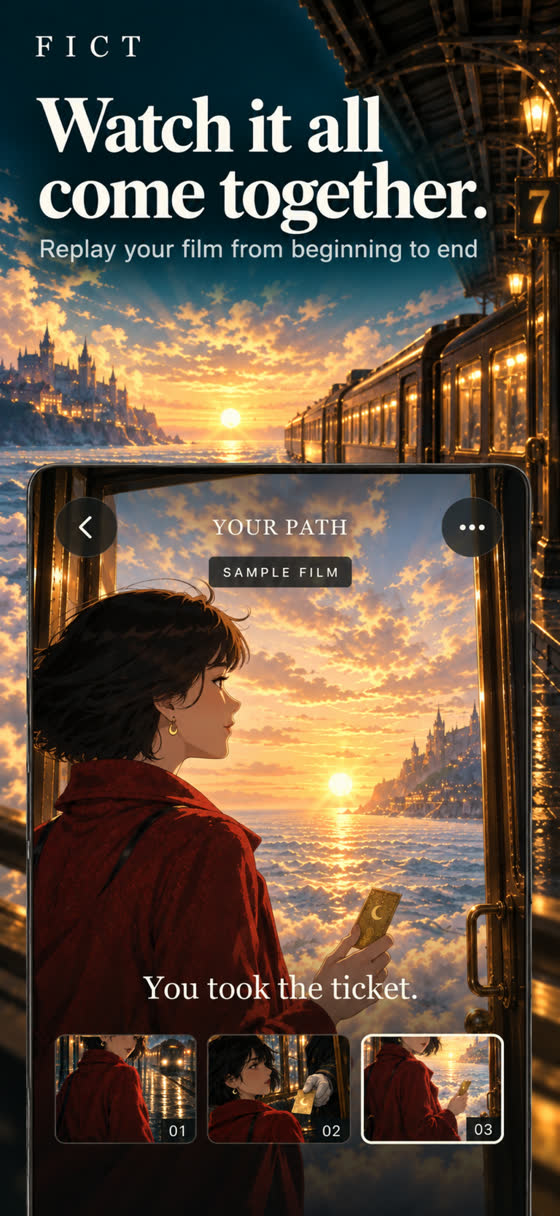
A choose your own adventure AI is an interactive story where artificial intelligence generates the next part of the plot from your choices, instead of following branches an author wrote in advance. Most are text-based and great for long roleplay; newer apps like FICT generate animated scenes, turning your choices into a replayable film.
Branching stories are older than computers. What has changed is who writes the branches. In a printed gamebook, every path exists before you open the cover. In an AI interactive story, the next page is written the moment you make your choice, which means there is no edge to the map.
This explainer traces how we got here, compares the two main kinds of AI choose your own adventure available today, text and video, and offers practical tips for getting better stories out of either.
From gamebooks to AI: a short history of branching stories
Gamebooks
The format most people picture comes from the Choose Your Own Adventure book series, which launched in the late 1970s. At the bottom of a page you would read something like "If you open the door, turn to page 42." Series such as Fighting Fantasy added dice and character stats. The charm was real, but so were the limits: a book can only hold so many pages, so every reader eventually discovers the same handful of endings. (Plenty of these are still worth reading; see our picks of choose your own adventure books for adults.)
Text adventures and interactive fiction
Early computer games like Zork let players type commands instead of flipping pages. You could try "go north" or "open mailbox," but the game only understood what its designers had anticipated. Interactive fiction grew into a rich hobby, and later, visual novels and narrative games added art and music. Branches were still hand-built.
Interactive film
Filmmakers experimented with audience choice for decades, and streaming brought it mainstream with titles like Netflix's Black Mirror: Bandersnatch in 2018. These are impressive but expensive: every branch has to be shot, so the number of real choices stays small. We cover this in more depth in a history of interactive movies.
AI text adventures
Large language models removed the ceiling. AI Dungeon, one of the best-known early examples, showed that you could type almost any action and get a coherent continuation. Since then, a wide range of AI story tools and browser-based generators have appeared, from polished apps to simple free generator pages. The common thread: the AI writes prose in response to what you type.
AI-animated branching films
The newest step adds pictures. Instead of a paragraph, each choice produces an animated scene. FICT works this way: you write a premise, watch a short animated scene, choose what happens next, and the choice becomes the next scene. The result is both a game and a film.
How an AI interactive story generator works
Regardless of format, the loop is similar:
- Setup. You provide a premise: characters, setting, tone, sometimes a genre or art style.
- Generation. The AI produces the opening, as text or as a scene.
- Choice. You pick from suggested actions or type your own.
- Continuation. The AI takes the story so far plus your choice and generates what happens next.
- Repeat until you decide the story is over.
The hard part for any AI adventure is memory: keeping characters, facts and tone consistent as the story grows. It is worth paying attention to how well a given app handles this, because it shapes the experience more than any single feature.
Text-based vs. video-based AI adventures
| Text AI adventures (e.g. AI Dungeon, generator sites) | Video AI adventures (e.g. FICT) | |
|---|---|---|
| What each turn gives you | A paragraph or more of prose | A 5 or 10 second animated scene with narration or dialogue text |
| Speed per turn | Usually a few seconds | Longer; video generation time varies with demand |
| Cost per turn | Low; many are free or cheap to use | Higher; FICT uses 10 credits per 5-second scene, 20 per 10-second scene |
| Depth of detail | Very high: inner thoughts, long dialogue, world lore | Focused: what you see and a line of narration |
| Freedom | Very open; many allow editing or retrying turns | Three suggestions or your own action; choices are permanent |
| What you end up with | A long transcript | A film you can replay start to finish |
| Best played | Anywhere, and especially suited to long sessions | On a phone, in short sessions |
When a text AI adventure is the better choice
- You want long, detailed roleplay with lots of dialogue and inner monologue.
- You like to revise: rewinding, editing the AI's output, trying a turn five ways.
- You care most about worldbuilding, lore and complex systems.
- You want to play for hours at low or no cost.
Text is the most flexible medium there is. If your imagination does the visuals just fine, a text adventure will usually give you more story per minute.
When a video AI adventure is the better choice
- You want to see your world: the light, the costumes, the art style.
- You would rather watch than read long passages.
- You want an artifact at the end: a film that replays from the first scene to the last.
- You are on your phone and have ten minutes, not two hours.
How FICT handles choose your own adventure
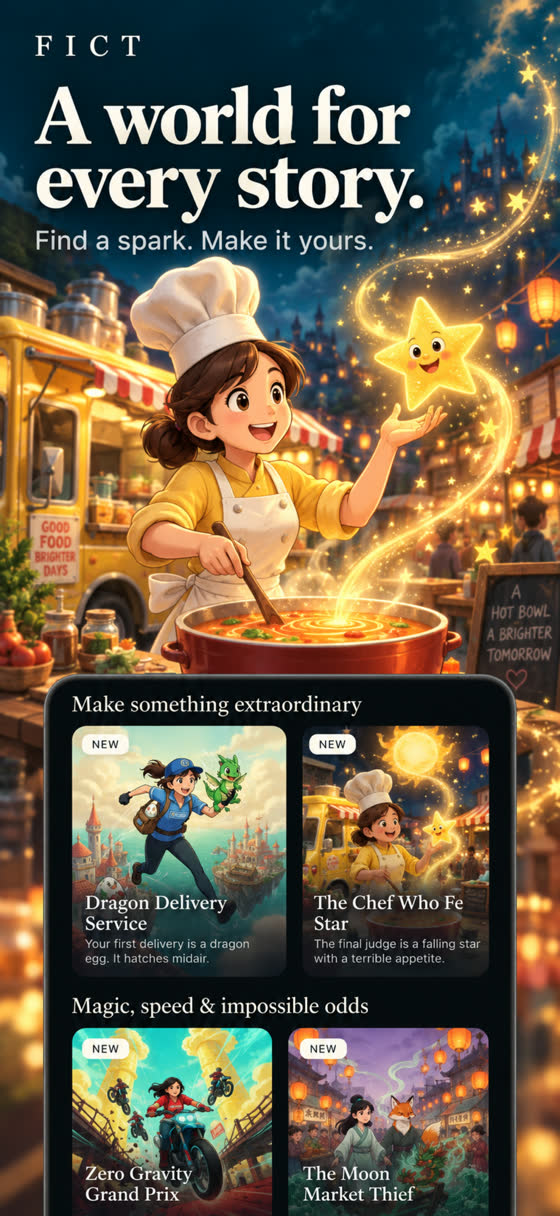
In FICT, you start from a "What if..." premise, describing your protagonist, world, mood and visual style (anime, watercolor, 3D and so on), or from a story on the in-app shelf. Genres range from fantasy adventures and romantic comedies to action, cozy slice-of-life and mystery. Characters are original and fictional.
Each scene ends with three suggested actions, and you can always write your own. Your choice becomes the next scene. Completed choices are permanent, so every film is a single path with consequences. Films have no fixed length; keep going as long as you like. You can read the story text while watching or hide it.
New players get 20 free credits, and the built-in sample film, The Last Train, is free to watch. If a generation fails, credits are refunded once, automatically. There is no login and no public feed, and your films live on your device. At the time of writing, optional subscriptions are FICT Director Weekly at US $8.99 and FICT Director Yearly at US $59.99; the app shows your local price.
Tips for better AI adventures, text or video
- Front-load the premise. Name the hero, their goal, the setting and the tone. The AI can only be as specific as you are.
- Write actions, not wishes. "She slips the ticket into her coat and steps off the train" works better than "something exciting happens."
- Keep one goal in view. A clear objective keeps the AI from wandering.
- Introduce complications yourself. If the story is too easy, write the problem: a locked door, a rival, a lie.
- Use the suggestions as a menu, not a rule. When none of the three options excite you, type your own.
- Know your ending. Decide roughly what kind of ending you want and steer toward it, even if the path surprises you.
For more on structure, see how to write a choose-your-own-adventure story. To compare apps, read the best interactive story apps, and for the bigger picture of AI film tools, see What Is an AI Movie Maker?

Write a “what if…”, watch the scene, choose what happens next. New players get 20 free credits.
Frequently asked questions
What is a choose your own adventure AI?
It is an interactive story where an AI writes or generates what happens next based on your choices. Unlike a printed gamebook with a fixed set of branches, the AI can respond to almost any action you type, so the story is not limited to paths an author wrote in advance.
Is there a choose your own adventure AI with video?
Yes. Most AI adventures are text-based, but some apps generate animated scenes. FICT turns each choice into a 5 or 10 second animated scene with narration or dialogue, and the scenes add up to a film you can replay start to finish.
Which is better, a text AI adventure or a video one?
It depends on what you want. Text adventures are faster, cheaper per turn, and better for long, detailed roleplay. Video adventures are better when you want to see the world and end up with a watchable film. Many people enjoy both for different moods.
Can I undo a choice in an AI interactive story?
It varies by app. Many text adventures let you retry or edit a turn. In FICT, completed choices are permanent, which keeps each film a single, coherent path, much like a real movie.
Are AI interactive stories private?
Check each app's settings, since some share stories publicly. FICT has no login and no public feed. Stories are private, films live on your device, and you can delete stories and data in Settings.